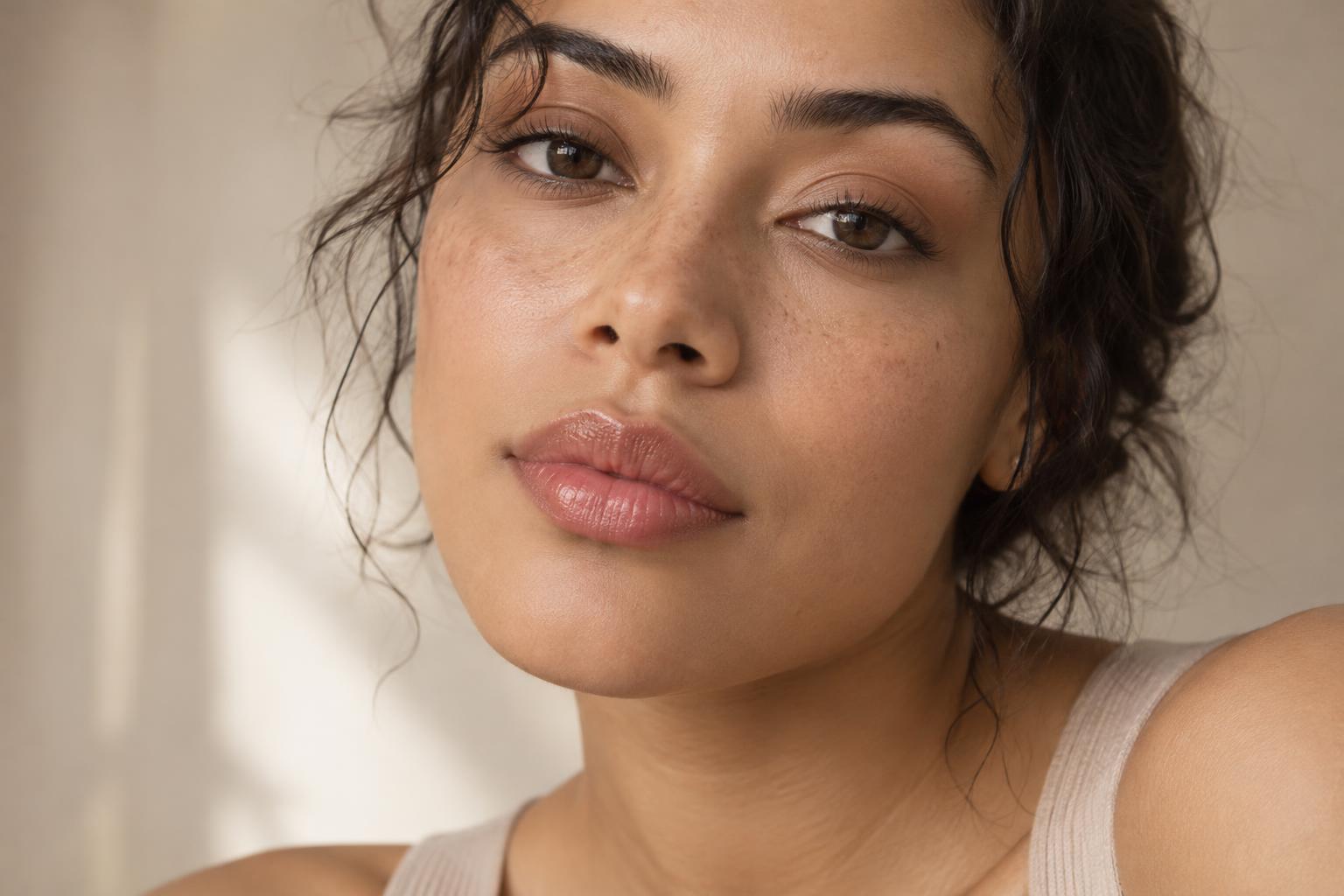
To apply lipstick on naturally two-tone lips, first decide whether you want your natural contrast to show or prefer a more uniform lipstick color. Choose sheer coverage for the first option; for the second, use a more opaque lipstick and add coverage selectively rather than applying thick layers everywhere.
Your upper and lower lip do not need to match. Both approaches are equally valid, and you can switch between them depending on the shade or look you want.
1. Decide how much natural contrast to keep
Before choosing a liner, look at your bare lips in natural light. Notice where the color changes: between the upper and lower lip, around the border, or through the center. Use this as an application map, not a list of things to correct.
- To preserve contrast: Choose a tinted balm, sheer lipstick, or translucent gloss. Apply a light layer across both lips and let the underlying colors remain visible.
- To soften contrast: Try a buildable lipstick, adding a little more only where you want greater coverage.
- To create a more uniform color: Choose an opaque lipstick and use liner where it helps connect the border with the center.
Gather your lipstick, an optional lip liner, a tissue, and a small lip brush if you want precision. A comfortable balm can help with prep, but blot away excess before applying color so the surface is not slippery.
2. Compare coverage—not just lipstick finish
Finish describes how lipstick looks on the surface, such as shiny, satin, or matte. Coverage describes how much of your natural lip color shows through. A matte lipstick is not automatically opaque, and a shiny lipstick is not automatically sheer.
For the most useful comparison, try a lipstick you own on both lips rather than judging it only from a hand swatch. Check it near a window, then in your usual indoor lighting.
If you want your natural lip color to show
Apply one light layer across both lips. Expect the color to look slightly different where your natural lip color differs—that can be part of the finished look. If you prefer shine to solid color, explore the guide to choosing a lip gloss.
If you want a more even lipstick color
Look for coverage that approaches your desired result in a thin application. If several layers still leave more contrast than you want, consider a more opaque formula rather than continuing to stack product.
3. Use lip liner selectively
You do not need to outline and fill every part of your lips. Start where definition would help: a section of the border, the corners, or a transition between the edge and center.
- For a uniform lipstick look: Choose a liner close to the lipstick shade.
- For a softly defined, natural look: Try a liner close to the lip border you want to emphasize.
- For a deeper outline: Choose a slightly deeper liner and blend inward deliberately, rather than leaving a hard ring.
Use short, light strokes along your natural lip edge. Then feather the liner inward with the pencil or a lip brush. Where you want extra coverage, lightly shade that area instead of filling both lips automatically.
If your lip borders have different colors, no single “natural” liner has to match every section. Choose it according to the finished look you want.
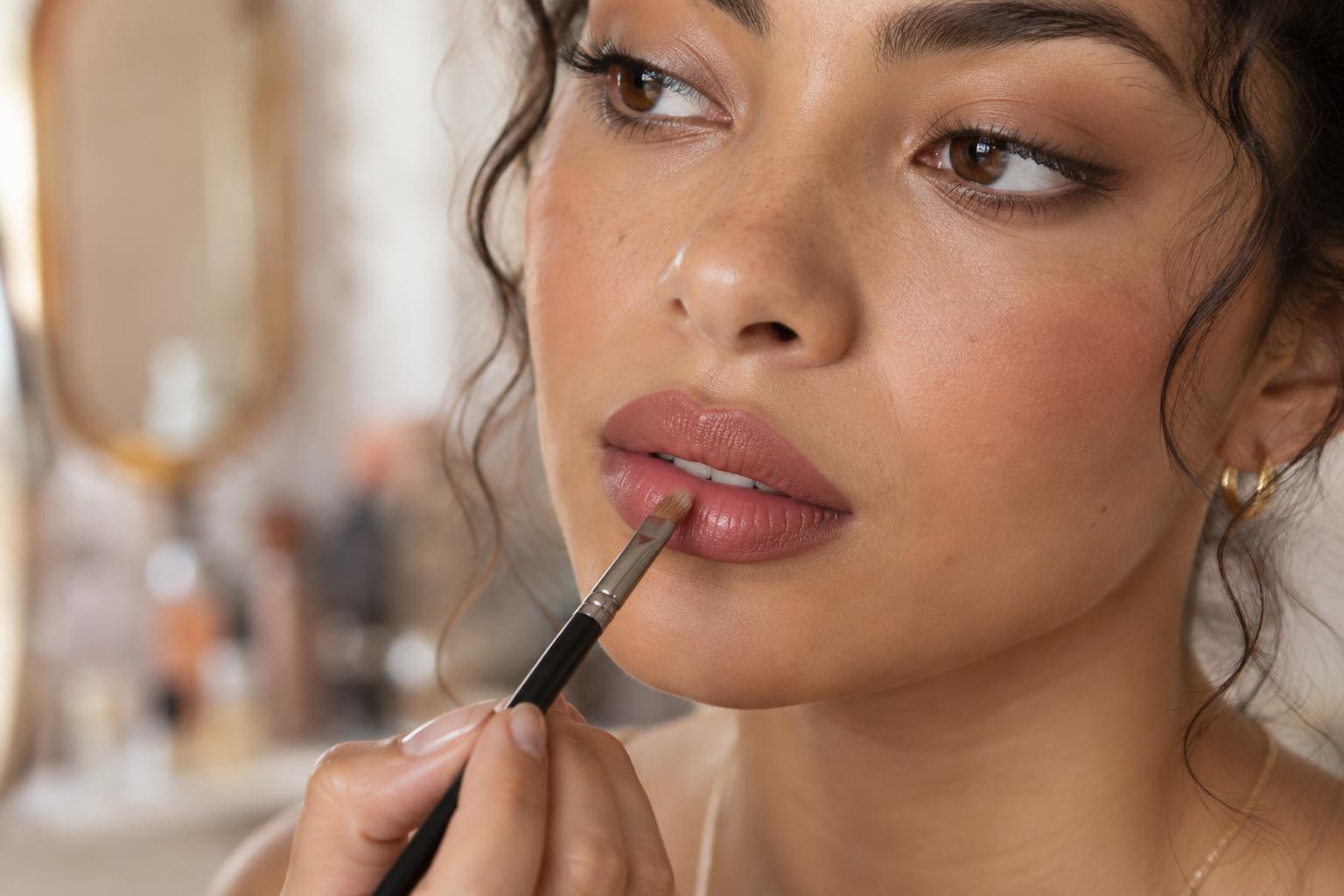
4. Build lipstick coverage only where needed
This method lets you adjust the result without making every area equally thick.
- Apply a thin first layer. Sweep or brush lipstick across both lips, keeping the amount light enough to assess.
- Check both lips separately. Relax your mouth and notice where the lipstick looks more translucent or different in tone.
- Add targeted coverage. Tap a little more lipstick onto those areas with a brush or the tip of the bullet. Either lip may need the extra layer; do not assume it will always be the darker one.
- Blend the transitions. Use small strokes to connect the added color with the surrounding lipstick, including any liner.
- Check at conversational distance. Step back from the mirror before adding more. Stop when the result matches your preference.
If the surface feels overloaded, gently blot once and reassess. Avoid repeatedly rubbing your lips together if it moves color away from the areas you just covered. For liquid formulas, follow the product’s application directions rather than continually brushing over a setting layer.
5. Troubleshoot pale nudes and uneven-looking color
Your nude looks pale or gray
Try a slightly deeper nude first, or compare it with a shade that has more rose, brown, peach, or another visible color you enjoy. “Nude” does not have to mean beige or lighter than your lips.
A liner close to your lip border can connect a lighter lipstick to the edges. However, if you dislike the color across the whole lip, changing the lipstick shade may be simpler than adding more liner.
The outline looks separate from the center
Feather the inner edge of the liner farther inward, then brush lipstick across that transition. Keep the outer border defined only as much as you want.
One lip still looks different
If that difference bothers you, add a small amount of opaque color to the area showing through. If extra layering becomes heavy, start fresh with a more opaque lipstick. Foundation or concealer underneath is not a required step.
The lipstick looks patchy
Distinguish gaps in the product from natural color showing through an even sheer layer. Touch up actual gaps; leave visible contrast alone if preserving it was your goal. If application causes stinging or irritation, remove the product rather than layering over it.
FAQ
Why does the same lipstick look different on my upper and lower lip?
With sheer or partial coverage, your underlying lip color remains visible and affects the overall appearance. A more opaque lipstick can reduce that difference if you prefer a uniform result.
Can I wear sheer lipstick without hiding my natural lip color?
Yes. Apply a light, even layer and allow the contrast to show. Liner is optional; use it only where you want definition.
Should my liner match my lipstick or my natural lips?
Match the lipstick for a coordinated, more uniform look. Choose a shade close to your lip border for subtle definition, blending inward so the outline connects with the center.
How can I choose a nude that does not look pale or gray?
Compare slightly deeper shades and different color balances on both lips. Start with a nude closer to your lip color rather than assuming a light beige is the best match.