
The best way to apply makeup when you wear glasses is to adjust eye definition to your lenses, keep foundation thin where frames touch your skin, and emphasize lash lift rather than length. Check your makeup with your glasses on throughout the routine so you can see what actually shows.
Start With Your Glasses, Not Your Makeup
Clean your lenses before getting ready, then notice where your frames rest: the bridge, nose pads, upper cheeks, or some combination. These contact points need less product, not extra coverage.
If you cannot see comfortably without your glasses, use a close-up or magnifying mirror and work on one eye at a time. Keep eye tools steady and avoid bringing pointed applicators close to your eye when your vision is unclear.
Also check the fit. Frames that repeatedly slide down or press into your cheeks can disturb makeup regardless of your technique. An optician can assess whether an adjustment would help.
How to Reduce Foundation Transfer Around Nose Pads
Pressure, friction, and skin oils can all contribute to marks beneath glasses. A lighter base can reduce noticeable buildup, but no makeup routine can guarantee transfer-free wear.
Prep lightly and let skincare settle
Apply moisturizer where needed, followed by your usual sunscreen as directed. Let skincare settle before starting foundation. If your nose feels very slippery, gently blot excess surface shine with a tissue rather than layering primer over it.
Do not skip sunscreen or deliberately underapply it to improve makeup wear. Instead, look for a texture that feels comfortable beneath your makeup and glasses.
Use the least foundation at contact points
Apply foundation to the rest of your face first. Then use whatever remains on your sponge or brush around the bridge and sides of your nose. Add a pinpoint amount of concealer only where you still want coverage.
- Avoid thick layers: More foundation gives frames more product to displace.
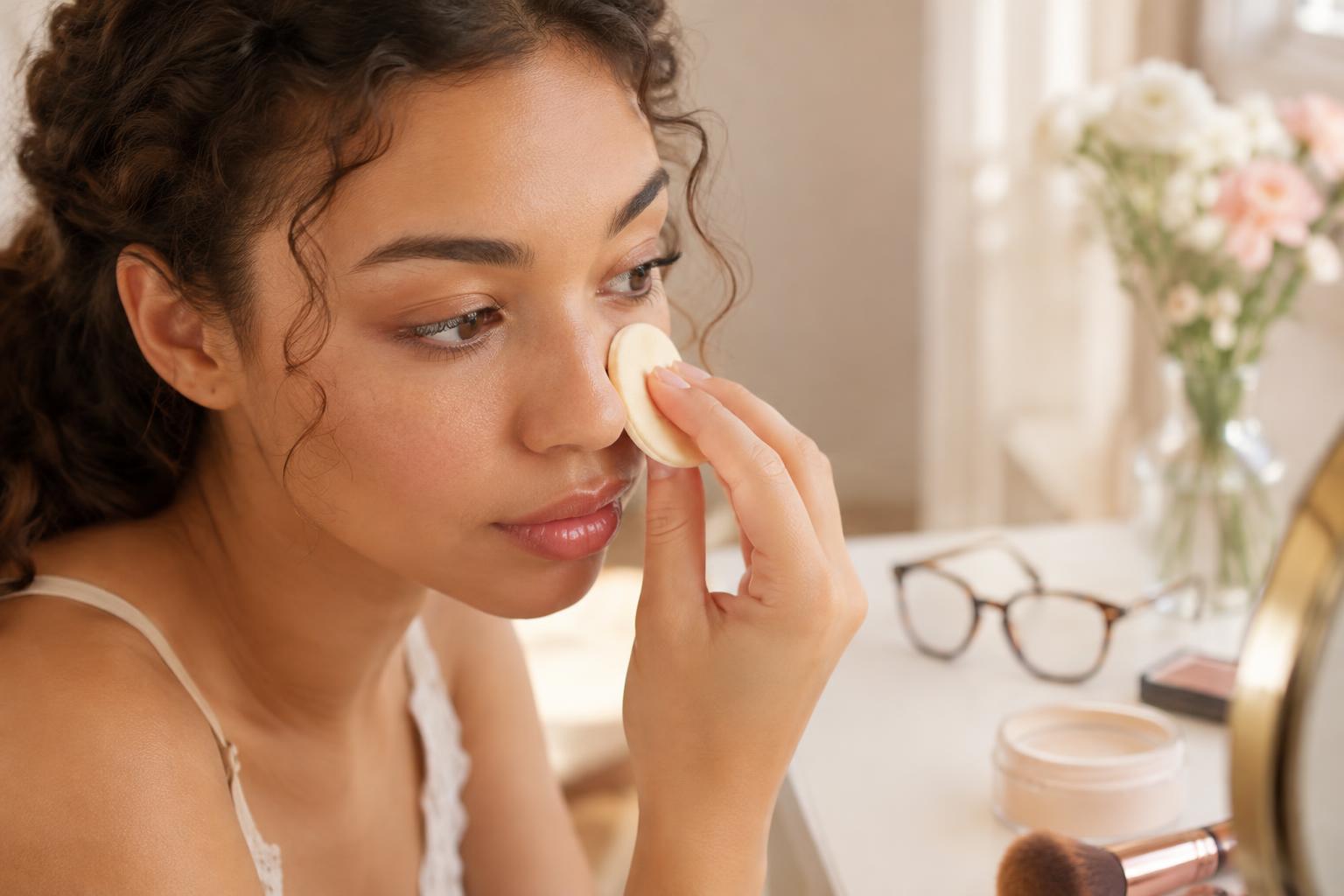
- Set selectively: Press a small amount of translucent powder onto contact areas with a puff or small brush.
- Remove excess: Sweep away loose powder before putting your glasses back on.
- Allow drying time: If you use setting spray, let it dry completely before replacing your frames.
For midday touch-ups, remove your glasses, blot oil, and gently tap the edges of any marks with a clean sponge. Add coverage only if necessary. Clean makeup residue from nose pads using a method approved for your frames and lenses; avoid improvised solvents.
Adapt Eye Makeup to Lenses That Make Eyes Look Smaller
Nearsighted prescriptions often make eyes appear smaller through the lenses. The effect varies with prescription strength and lens design, so use your reflection—not a rigid rule—to guide placement.
Keep the lid visible
Try a light or medium-toned shadow across the lid, then blend a slightly deeper shade into the crease and outer corner. A satin finish can add brightness without requiring loose glitter near the eyes.
Keep upper eyeliner relatively thin, especially toward the inner corner. A thick band can cover much of the visible lid. For extra definition, gently deepen the outer third or add a short upward flick that remains visible behind your frames.
If you line the lower eye, try a softly blended shadow along the outer third of the lash line rather than a heavy dark outline all the way around. Dark liner is still an option if you love it; the goal is intentional definition, not following a prohibition.
Adapt Eye Makeup to Lenses That Magnify Eyes
Farsighted prescriptions and many reading lenses can make eyes appear larger. They may also make uneven liner, mascara clumps, and shadow edges more noticeable.
Prioritize blending and precise edges
Apply shadow in thin layers and blend the boundaries with a clean brush. Matte or softly satin shades are useful when you want understated definition, while shimmer remains an option if you enjoy it.
For liner, make small strokes close to the upper lashes, then connect them. Brown, charcoal, or muted plum can provide a softer alternative to black. You do not need to make magnified eyes look smaller; simply choose the amount of contrast you like.
Use a light hand with under-eye concealer, too. Place it where discoloration is visible and blend outward instead of building a thick layer across the entire area.
Keep Your Lashes From Brushing Against Lenses
When lashes touch your glasses, adding length usually makes the problem more noticeable. Focus on upward lift, separation, and modest product buildup instead.
- Curl before mascara: On clean, dry lashes, position a clean curler carefully without catching the eyelid, then squeeze gently. Do not pull.
- Choose definition over dramatic length: Try a separating or curling mascara rather than one designed mainly to add long fibers.
- Apply sparingly at the tips: Concentrate a light coat near the roots and sweep through without repeatedly extending the ends.
- Let mascara dry: Wait before putting your glasses back on to reduce wet mascara marks on lenses.
Avoid curling lashes after mascara has dried, when they may stick to the curler. If your natural lashes still touch the lenses, have an optician check the frame fit rather than bending the frames yourself.
Balance Brows, Cheeks, and Lips With Your Frames
Brush brows into place and fill sparse areas with light strokes. You do not need heavier brows simply because you wear bold frames.
Apply blush with your glasses on initially so you can see where the color sits. Blend it around, rather than directly beneath, any frame contact point. Finish with whichever lip color balances the look for you: tinted balm, a neutral lipstick, or a brighter shade.
FAQ
Should eyeliner be thicker when you wear glasses?
Not necessarily. Start thin, put your glasses on, and build only where definition disappears. Thick liner can overwhelm limited lid space, especially when lenses make eyes look smaller.
Can setting powder stop glasses from leaving foundation marks?
A light application may help, but it cannot eliminate pressure or friction. Thin foundation layers, clean nose pads, and well-fitting frames matter too.
Is waterproof mascara best for glasses wearers?
Only if it suits your needs. It may help with moisture-related smudging, but it will not prevent long lashes from touching lenses. Lash lift and frame clearance address that problem more directly.
Can I wear false lashes with glasses?
Yes. Choose shorter, upward-curving styles and check clearance before committing to the look. Follow adhesive directions, keep glue out of your eyes, and remove the lashes if irritation develops.